
PRVS Blog
Victron Energy RV Solar Integration Guide for North Texas
Denton area RV owners often find that standard factory battery setups cannot support a week of remote camping. Moving to an expert solar system ensures your lights, fridge, and Starlink stay powered anywhere in North Texas.
Victron Energy RV solar integration is the gold standard for travelers who want to live off the grid without losing power. This smart system connects solar panels, lithium batteries, and inverter units into a single network that manages your energy use. It allows you to run high-draw items like air conditioners, microwaves, and Starlink setups while you camp in remote areas of North Texas or Oklahoma. By using expert parts like the MultiPlus inverter and SmartSolar charge controllers, you get RV solar and off-grid solutions that charge faster and last longer. These systems provide smooth power switching and remote tracking through a mobile app so you can skip the generator and enjoy steady power.
Schedule your Victron Energy RV solar integration consultation with Patriots RV Services in Denton, TX, today. Our certified technicians design and install complete Victron power systems for North Texas RV owners who demand reliable off-grid performance.
Setting up a reliable power system is the first step toward successful boondocking. RV owners across North Texas, Oklahoma, and Arkansas are moving to Victron-based setups because the ecosystem delivers something no other brand matches: component-level integration through the VE.Bus and VE.Can communication protocols. The result is a power system where every part operates with full awareness of the others. From the MultiPlus inverter to the SmartSolar MPPT charge controller to the Cerbo GX system monitor. Understanding how these components work together is the key to designing a system that fits your specific travel style.
Why Victron Energy Leads the RV Solar Integration Market
Victron Energy has earned its reputation among serious RV owners through engineering that prioritizes reliability, scalability, and precise system control. Unlike consumer-grade solar components that operate in isolation, Victron builds a complete ecosystem where every device shares data over the VE.Bus or VE.Can data bus. This means your inverter knows the battery state of charge before deciding whether to draw from solar. Shore power, or the alternator, and it makes those transitions in under 20 milliseconds without dropping a single load.
For North Texas RV owners who camp in extreme summer heat, component reliability is non-negotiable. Victron's MultiPlus inverter features a conformal-coated circuit board that resists humidity and vibration. And its aluminum chassis acts as a heat sink to dissipate the thermal load from sustained 120A charging cycles. These are not marketing features; they are engineering decisions that matter when your system runs at full output under a July sun.
Ecosystem Integration versus Standalone Components
The most common mistake RV owners make when building a solar system is mixing components from different manufacturers. A Renogy charge controller paired with a Go Power inverter and a generic battery monitor does not give you a unified view of your energy system. Each part operates on its own logic, and there is no central brain coordinating charge profiles, load shedding, or state-of-charge accuracy. Victron eliminates this problem entirely. The Cerbo GX serves as the system hub. Aggregating data from every Victron device over VE.Can and presenting it on the GX Touch 50 display and the VRM Portal. When the SmartSolar MPPT detects a drop in solar harvest, the Cerbo GX can trigger a configurable signal. When the Orion XS DC-DC charger reaches float voltage from alternator charging, it communicates that status back to the network.
Built for Harsh Operating Conditions
Patriots RV Services in Denton, TX, installs Victron systems because the hardware is designed for the vibration, temperature swings, and dust that come with life on the road. The MultiPlus-II uses a toroidal transformer rather than a less expensive EI-laminated core, which reduces audible hum and improves efficiency at partial loads. The SmartSolar MPPT controllers use an aluminum epoxy-sealed housing that protects the electronics from moisture ingress. For a customer who plans to explore the back roads of Oklahoma and Arkansas, this build quality means fewer service intervals and longer component life. See our RV solar and off-grid solutions for examples of complete Victron installations we have completed.
Scalable Architecture for Growing Needs
A well-designed Victron system grows with you. Start with a 12V 3000VA MultiPlus-II, a single Epoch 460ah LiFePO4 battery, and 600W of solar. When you decide to add a second air conditioner or transition to full-time living, the same MultiPlus-II can be paralleled with a second unit. The battery bank expanded with additional Epoch modules, and the solar array extended through the same SmartSolar controller's spare channel. No components need to be removed and replaced. Patriots RV Services designs every system with expansion in mind, so your initial investment is never wasted.
Key Components of a Victron RV Solar System
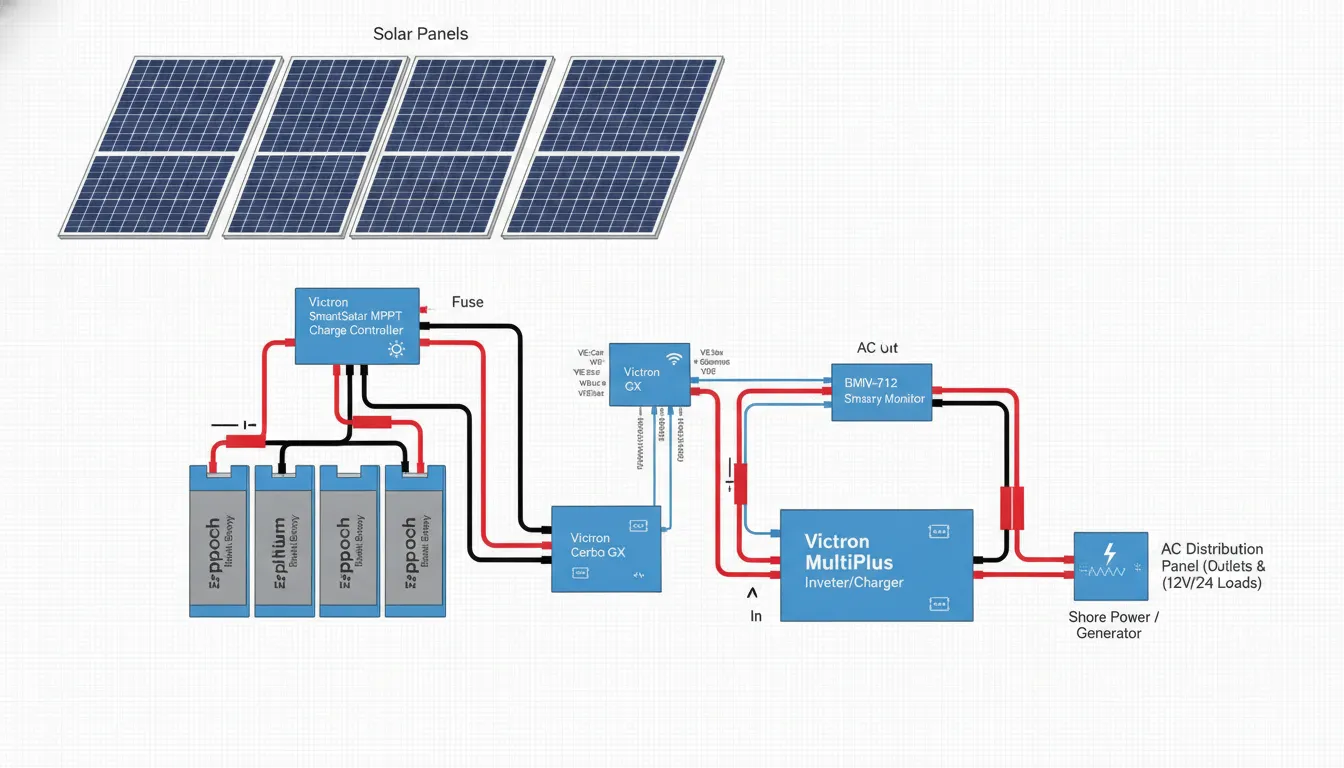
A properly specified RV solar and off-grid system requires components that are correctly matched to each other and to your power demands. Patriots RV Services uses the Victron Energy line exclusively for its engineering consistency and the interoperability guarantees that come with a single-manufacturer ecosystem. Each component serves a specific function within the power architecture, and understanding those roles helps you make informed decisions about your system design.
Power Management and Inversion
The MultiPlus-II inverter/charger is the central power node in a Victron RV system. It performs three functions: inverting DC battery power into 120V AC for your appliances, charging the battery bank from shore power or a generator at up to 120A. And transferring between sources within 20 milliseconds so sensitive electronics like CPAP machines and Starlink terminals do not reset during a power transition. The 3kVA 12V model handles everything except air conditioning for most RVs, and parallel configurations of two or more units support full AC loads including roof-mounted air conditioners.
The Orion XS DC-DC charger fills a critical role during travel days. This unit accepts up to 50A from your engine alternator and delivers a multi-stage charge profile to the lithium house bank. Without an Orion XS, your alternator would need to run continuously at high output to charge depleted lithium batteries, which can overheat and damage a standard RV alternator. The Orion XS protects both the alternator and the battery bank by regulating current flow and temperature. For diesel-powered coaches, Patriots RV Services also offers RV diesel chassis service to ensure your engine's charging system is ready for the added load.
Solar Harvest and MPPT Control
The SmartSolar MPPT charge controller extracts maximum power from your solar panels by continuously sampling the panel voltage and adjusting the load to find the peak power point. The 100/50 model handles up to 375W of solar at 12V, and multiple controllers can be paralleled for larger arrays. Victron's proprietary algorithm outperforms standard PWM controllers by 20 to 30 percent in real-world conditions, particularly in partial shade or overcast weather common during North Texas spring storms. Each controller reports its harvest data to the Cerbo GX, so you see real-time wattage from every panel group on the VRM Portal.
Lithium Battery Storage and Monitoring
Epoch 460ah LiFePO4 batteries are the standard choice for Victron installations at Patriots RV Services. Lithium iron phosphate chemistry delivers 3000 to 5000 cycles at 80 percent depth of discharge versus 500 cycles at 50 percent for lead-acid. The usable capacity difference is substantial: a single 460ah Epoch provides roughly 5000 watt-hours of usable energy. While a lead-acid bank of the same nominal capacity would deliver only 2300 usable watt-hours because deeper discharge damages the cells. Patriots builds custom aluminum battery trays sized to each RV's basement compartments, with compression-fit foam inserts that prevent movement during transit.
The Cerbo GX and GX Touch 50 display provide real-time visibility into every electrical parameter: battery voltage, state of charge in percent. Current flow in both directions, remaining capacity in watt-hours, solar harvest in watts, and AC load in watts. This data also streams to the Victron Remote Management Portal, accessible from any web browser or mobile device.
| Component | Primary Function | Key Specification |
|---|---|---|
| MultiPlus-II 12/3000 | Inverter and AC Charger | 3kVA continuous / 120A charge / 20ms transfer |
| SmartSolar MPPT 100/50 | Solar Charge Controller | 100V max input / 50A output / 375W at 12V |
| Cerbo GX + Touch 50 | System Monitor and Hub | VE.Can / VE.Bus / VRM Portal / 7-inch display |
| Orion XS 12-12/50A | DC-DC Alternator Charger | 50A output / programmable charge profile |
| Lynx Distributor | Power Distribution and Fusing | Integrated bus bars / M10 fuse holders / 1000A rating |
| Epoch LiFePO4 460ah | Energy Storage | 460ah / 5000 cycles / integrated BMS |
How to Design Your North Texas Boondocking System
The right system configuration starts with a detailed power audit. Patriots RV Services follows a structured design methodology that matches component capacity to your actual usage patterns. This ensures your Victron Energy RV solar integration performs reliably whether you are spending a weekend at Lake Texoma or a month in the Ouachita National Forest.
Conduct a Load Assessment
The first step is measuring your daily energy consumption in watt-hours. A residential refrigerator draws 100 to 200 watt-hours per day. LED lighting adds 30 to 60 watt-hours. A Starlink terminal consumes 60 to 80 watt-hours over an evening use period. A microwave requires 1000 watts but runs briefly. The critical question is whether you need air conditioning while boondocking. A 13,500 BTU RV AC unit draws 1500 to 2000 watts running, which at 12V translates to roughly 140 amps of DC current. Running it for six hours consumes over 800 amp-hours from the battery bank. Which requires a 24V or 48V system with 600ah+ of lithium and 1200W+ of solar to sustain.
For the majority of RV owners who do not plan to run AC off-grid. A 12V system with 200ah to 400ah of lithium delivers three to five days of autonomy for lights. Water pump, TV, Starlink, and device charging without any solar input. Patriots RV Services works through this analysis with every customer during the consultation phase. For those who also need reliable climate control in their RV, we offer RV AC repair and upgrade services as part of the system design.
Sizing the Solar Array and Battery Bank
Roof space is the limiting factor for most RVs. A typical 35-foot coach roof accommodates 800W to 1200W of solar panels, with careful positioning to avoid shading from AC units, satellite domes, and roof vents. North Texas averages 5.2 peak sun hours per day in summer and 3.1 in winter. So a 1000W array generates roughly 5000 watt-hours in July and 3100 watt-hours in December. Battery bank capacity should provide at least two days of autonomy at your calculated daily load, covering consecutive overcast days.
Epoch 460ah LiFePO4 batteries are the standard building block. One battery provides roughly 5000 watt-hours of usable capacity. Two batteries in parallel provide 10,000 watt-hours, enough to run a residential fridge, lights, water pump, entertainment, and Starlink for four to five days without solar recharge. Patriots designs custom battery trays for each installation, with proper compression and ventilation for the lithium cells.
Inverter Selection by Load Profile
The MultiPlus-II 12/3000 is the appropriate choice for most non-AC applications. It delivers 3000VA of continuous AC power, which handles a microwave, induction cooktop, hair dryer on low, and all entertainment loads simultaneously. If you need air conditioning off-grid, the system steps up to a 24V or 48V MultiPlus-II configuration with a larger battery bank and higher solar capacity. Patriots RV Services selects the inverter tier based on your power audit, not a one-size-fits-all approach. Our team designs custom RV solar and off-grid solutions built around how you actually travel.
Contact Patriots RV Services at (940) 488-5047 to schedule a power audit and system design consultation. Our technicians will help you select the right components for your North Texas boondocking setup.
Step-by-Step Victron System Installation Process
Professional Victron Energy RV solar integration requires a methodical installation sequence that ensures electrical safety, mechanical durability, and long-term system reliability. Patriots RV Services follows a documented build process at our Denton, TX facility, with each stage inspected before the next begins.
System Design and Component Selection
Every installation begins with a detailed power audit and electrical system assessment. Our technicians verify the existing wiring gauge, identify the battery compartment dimensions, and confirm the roof layout for solar panel placement. We select the MultiPlus-II variant that matches the power audit results and order all Victron components, cable assemblies, fusing, and battery trays as a matched set. This eliminates the compatibility issues that arise when components are sourced from different suppliers.
Custom Fabrication and Hardware Installation
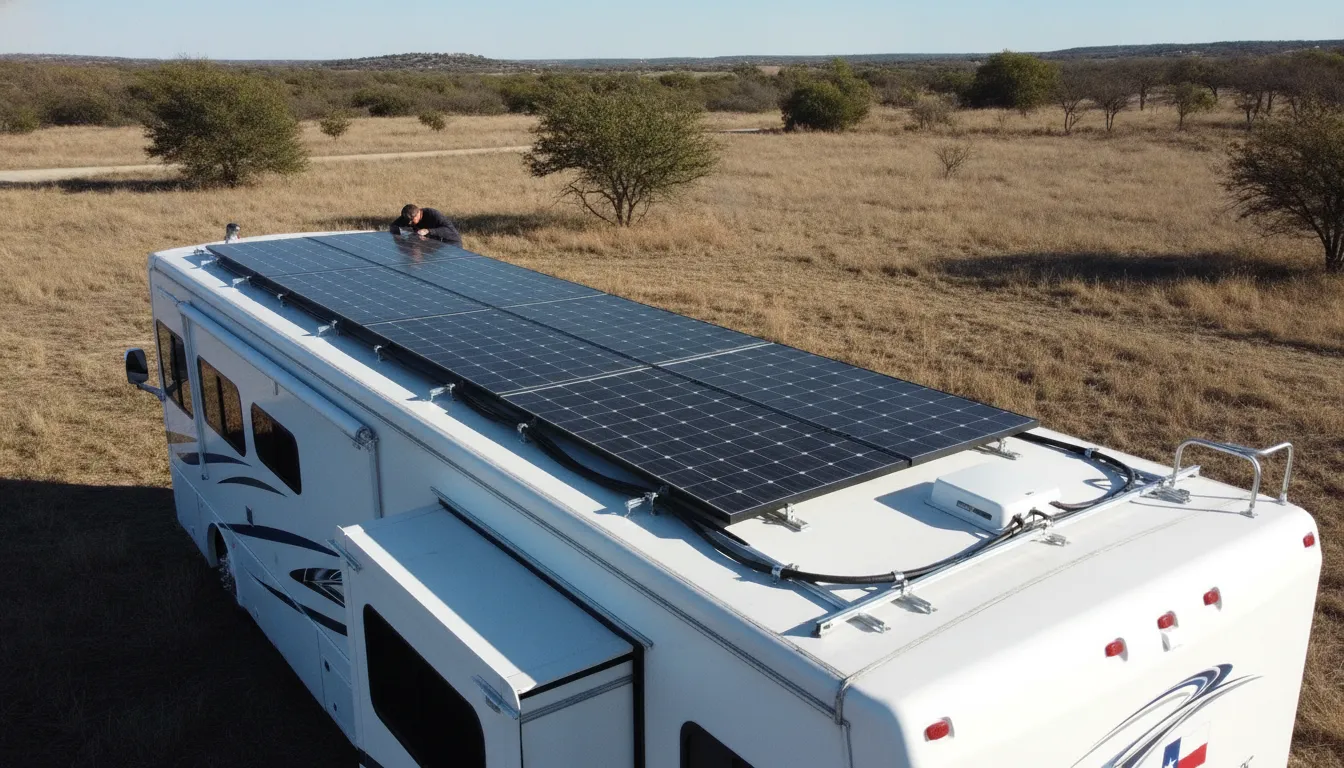
Vibration resistance separates a professional installation from a DIY setup. Patriots RV Services fabricates custom aluminum battery trays with rubber isolation mounts that prevent the Epoch 460ah batteries from shifting during travel. Every tray includes a compression plate with threaded rod to maintain consistent cell stack pressure. Solar panels are mounted using stainless steel brackets with butyl tape seals under each foot and a Dicor lap sealant cap. Preventing the roof penetrations from becoming leak points.
- Power audit and load calculation. Our technicians measure your daily watt-hour consumption, peak surge loads, and alternator capacity to establish the system design parameters.
- Component selection and procurement. The correct MultiPlus-II model, SmartSolar MPPT controllers, Orion XS DC-DC charger, Cerbo GX, Lynx distributor, and Epoch batteries are specified and sourced as a complete system.
- Custom battery tray fabrication. Welded aluminum trays with isolation mounts and compression plates are built to fit your RV's specific battery compartment dimensions.
- Solar panel layout and roof mounting. Panels are positioned for maximum solar exposure using a shade analysis, then mounted with sealed stainless steel brackets.
- MultiPlus-II and Cerbo GX integration. VE.Bus cables connect the inverter to the Cerbo GX hub, and VE.Can wiring ties all devices into the monitoring network.
- Lynx distributor and circuit protection. The Lynx Power In and Lynx Distributor consolidate all high-current connections with MRBF fuses rated to each circuit's ampacity.
- System commissioning and performance testing. A full load bank test validates every circuit before the system is activated and the VRM Portal is configured.
Wiring Standards and Cable Management
All DC wiring in a Patriots-installed Victron system uses tinned marine-grade cable with heat-shrink ring terminals. VE.Bus cables for the MultiPlus-to-Cerbo GX data link and VE.Can cables for device-to-device communication are run separately from AC power cables to prevent electromagnetic interference. Every cable is labeled at both ends with the circuit designation, and the Lynx Distributor's transparent cover allows visual inspection of fuse status without removing any covers. For customers who also need slide-out or roof repairs during their service visit, we offer RV roof repair alongside the electrical work.
Safety Systems and Overcurrent Protection
The Victron Lynx Power In and Lynx Distributor provide the system's overcurrent protection architecture. The Lynx Power In accepts the main battery positive cable through a bolted connection rated for continuous current. While the Lynx Distributor provides MRBF fuseholders for each branch circuit. Each fuse is sized to protect the wire gauge on that circuit, not the connected device, which is the correct engineering practice. Class T fuses between the battery bank and the MultiPlus-II handle the high interrupt current that lithium batteries can deliver during a short circuit event.
Monitoring and Managing Your Victron Energy System
One of the defining advantages of a Victron Energy RV solar integration is the depth of operational data the system provides. Rather than guessing whether you have enough battery capacity for another night of dry camping, you see exact state-of-charge percentages. Time-to-empty projections based on your actual consumption rate, and historical solar harvest data that helps you optimize your power usage.
GX Touch 50 Display: Real-Time System Visibility
The GX Touch 50 is a 7-inch touchscreen display that connects to the Cerbo GX over a standard HDMI cable with USB touch overlay. It shows battery voltage, state of charge, remaining capacity in amp-hours and watt-hours, current DC load in amps, solar harvest in watts, and AC load in watts. The display also shows the status of each connected Victron device, including firmware versions, operating modes, and any active alarms. This single screen replaces the need for separate battery monitors, inverter remotes, and charge controller displays.
VRM Portal: Remote Access from Anywhere
The Victron Remote Management Portal lets you check your system from any web browser or mobile device. When your RV has cellular or WiFi connectivity, the Cerbo GX uploads real-time data to the VRM Portal. Including historical graphs of battery state of charge, solar harvest curves, and inverter load profiles. You can see whether your batteries reached full charge during the day while you were away hiking. And you can remotely configure the inverter's power assist mode or adjust the charger's absorption voltage. This remote visibility is particularly valuable for North Texas RV owners who store their rigs for part of the year and want to confirm the solar system is maintaining the battery bank.
SmartShunt and VictronConnect Integration
The SmartShunt is a high-precision battery monitor that measures current flow in and out of the battery bank using a 500A shunt. It communicates the data to the Cerbo GX over Bluetooth, providing the state-of-charge calculation that drives the entire system's charge and discharge decisions. The VictronConnect app gives you direct Bluetooth access to individual devices for in-person tuning, such as setting the SmartSolar MPPT's absorption voltage or updating the MultiPlus-II's firmware. If you need support configuring these tools, Patriots RV Services offers comprehensive RV services and repairs to keep your electrical system operating at peak performance.
How Much Does a Victron RV Solar System Cost?
The cost of a Victron Energy RV solar integration depends primarily on three variables: battery bank capacity, inverter voltage tier, and solar array size. Patriots RV Services structures its pricing around these factors so you can select the system that matches your budget and energy requirements.
Solar Starter Packages: Weekend and Occasional Use
For RV owners who camp primarily at sites with partial hookups and want to reduce generator runtime, Solar Starter Packages range from $4,995 to $7,995. These systems include a MultiPlus-II 12/3000 inverter, one Epoch 460ah lithium battery. A SmartSolar MPPT charge controller with 400W to 600W of solar, and full professional installation with the Cerbo GX monitoring system. These packages cover lights, water pump, TV, Starlink, and device charging for two to three days of autonomous operation.
Full Custom Off-Grid Systems: Extended Boondocking
Custom systems for full off-grid capability range from $12,000 to over $30,000, depending on the specifications. These include a larger battery bank of 600ah to 920ah of Epoch lithium, a MultiPlus-II configured for the appropriate voltage tier. 800W to 1200W of solar, the Orion XS DC-DC charger, and full Cerbo GX monitoring with the GX Touch 50 display. These systems support all AC loads except air conditioning at the 12V tier, and the 24V or 48V tier adds air conditioning capability.
Cost Drivers and Investment Value
Battery bank size is the largest single cost driver. Epoch 460ah LiFePO4 batteries represent roughly 30 to 40 percent of the total system cost. Inverter selection is the next factor, with 24V and 48V MultiPlus-II units priced higher than 12V models due to their higher component ratings and larger transformer size. Solar array cost scales linearly with wattage, and custom battery tray fabrication adds a labor component that varies by RV model. Professional installation from Patriots RV Services ensures every connection is torqued to specification. Every fuse is sized correctly, and every cable is routed to prevent chafing against chassis components. Contact us to learn more about our custom RV solar and off-grid solutions and schedule a consultation.
Frequently Asked Questions
You still have questions about building a Victron-powered RV. Here are answers to the most common ones we hear from North Texas RV owners.
Can you run an RV completely on solar power?
Yes, but the system must be properly sized. A 12V system with 400ah to 600ah of lithium batteries and 600W to 1200W of solar can power lights, fridge, TV, and Starlink indefinitely in good sun. To run air conditioning, you need a 24V or 48V system with a larger battery bank and enough solar to recharge daily. Patriots RV Services designs systems for full off-grid capability.
What are the disadvantages of Victron inverters?
Victron inverters cost more than entry-level brands, and the full ecosystem requires compatible components for best performance. However, the higher upfront cost pays off in reliability, efficiency, and lifespan. Professional installation from Patriots RV Services ensures your system is configured correctly from day one.
Should RV solar panels be wired in series or parallel?
It depends on your charge controller and panel voltage. Series wiring increases voltage, which can be better for MPPT charge controllers in low-light conditions. Parallel wiring keeps voltage low but increases current. The Victron SmartSolar MPPT controllers work well with series strings up to their rated voltage. Patriots RV Services designs the optimal wiring layout for your specific panels and controller.
What is the 120 rule for solar panels?
The 120 rule refers to the National Electrical Code requirement that solar panel string voltage must not exceed 120% of the charge controller maximum input voltage in cold temperatures. For a Victron SmartSolar MPPT 100/50, the maximum input voltage is 100V, so the string must stay below 100V even in cold conditions when panel voltage rises. Professional installers account for this when designing your array.
How much does RV solar cost at Patriots RV Services?
Solar Starter Packages range from $4,995 to $7,995 for basic systems. Larger custom systems for full off-grid capability can go up to over $30,000. The final cost depends on your battery bank size, inverter capacity, solar array, and system complexity. Call (940) 488-5047 for a free consultation.
Ready to Build Your Victron RV Solar System?
Ready to build your Victron Energy RV solar integration system? Patriots RV Services in Denton, TX, designs and installs custom Victron power systems for RV owners across North Texas, Oklahoma, and Arkansas. Our veteran-owned team has the expertise to build a system that matches your travel style and budget.
Call us today at (940) 488-5047 to schedule a consultation. You can also visit our website to learn more about our RV solar and off-grid solutions. We are located at 11399 US-380 W, Krum, Texas 76249, just west of Denton. Let us help you take your RV adventures beyond the campground.