
Wheel bearings carry the load at every mile a towable RV travels. Worn grease, a leaking seal, or incorrect adjustment can create heat, tire damage, brake contamination, and a serious wheel-end failure. This RV wheel bearing repack guide from Patriots RV Services gives Denton and North Texas RV owners a practical maintenance plan before the next trip.
Call Patriots RV Services at (940) 488-5047 to schedule an RV wheel bearing inspection.
How Often Should You Schedule an RV Wheel Bearing Repack?
For many towable RVs, an RV wheel bearing repack is a sensible starting point every 12 months or 12,000 miles, whichever comes first. The axle and hub manufacturer’s instructions control the final interval. Annual service still matters for a trailer that sits because grease ages, seals deteriorate, and storage history may be incomplete.
The 12-month or 12,000-mile point is a planning reference, not a universal rule for every axle, hub, or lubrication system. Confirm the interval for the actual axle and hub on your RV. The equipment manufacturer’s procedure takes priority when it specifies a different lubricant, inspection method, or service interval.
Time matters even when mileage is low. A trailer that moves only a few hundred miles can still have lubricant that has aged or absorbed moisture. Storage also exposes seals and grease to temperature changes. Before a long trip, move service higher on the list when the trailer has been parked for months or the last maintenance date cannot be confirmed.
Give the wheel ends extra attention after heavy use, steep grades, frequent braking, long travel in hot weather, or recent work on the hub and brake assembly. These conditions do not create a new universal interval. They do make a pre-trip inspection more valuable.
An exterior grease fitting does not prove that the bearings, races, seal, and spindle have been inspected. Depending on the hub design, a complete evaluation may require removing the hub. Unknown service history does not prove damage, but it also does not prove readiness for travel.
NHTSA safety information shows why lubrication and wheel-end failures deserve prompt attention. If a hub is hot, noisy, loose, or leaking, do not wait for the calendar interval. Have the condition evaluated before towing again.
| Maintenance checkpoint | What to confirm | Why it matters |
|---|---|---|
| Service interval | 12 months or 12,000 miles, unless the axle or hub maker specifies another interval | Creates a practical starting point for planning service |
| Service history | Last repack date, mileage, parts replaced, and lubricant used | Helps identify unknown risk before a long trip |
| Warning signs | Heat, noise, play, vibration, smoke, or grease leakage | Indicates the RV needs evaluation before towing |
What Happens During a Proper Bearing Inspection?
A proper RV wheel bearing inspection secures the trailer, opens the hub as needed, cleans the parts, and checks each cone, race, seal, and spindle for damage. It also evaluates grease and nearby brake components before reassembly. The service record should identify findings, replaced parts, lubricant, and the adjustment procedure used.
A complete inspection combines safe support, disassembly, cleaning, measurement, and replacement decisions. Patriots RV Services treats wheel-end maintenance as more than adding grease from outside the hub. The technician should identify the axle and hub configuration, follow the applicable procedure, and document findings before returning the RV to service.
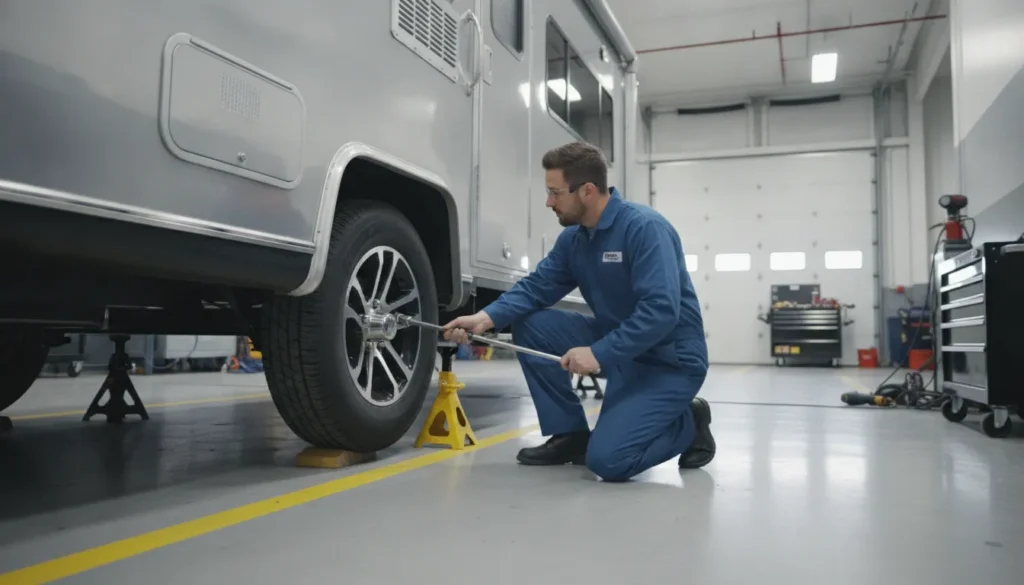
- Secure the RV and work area. Prevent the trailer from rolling and support it with equipment rated for the vehicle. Wheel-end work requires stable support before a wheel or hub is removed.
- Remove the wheel and hub as required. The amount of disassembly depends on the axle, hub design, service history, and initial findings. Access to the inner and outer bearing cones, races, seal, and spindle provides a more useful evaluation than an exterior glance.
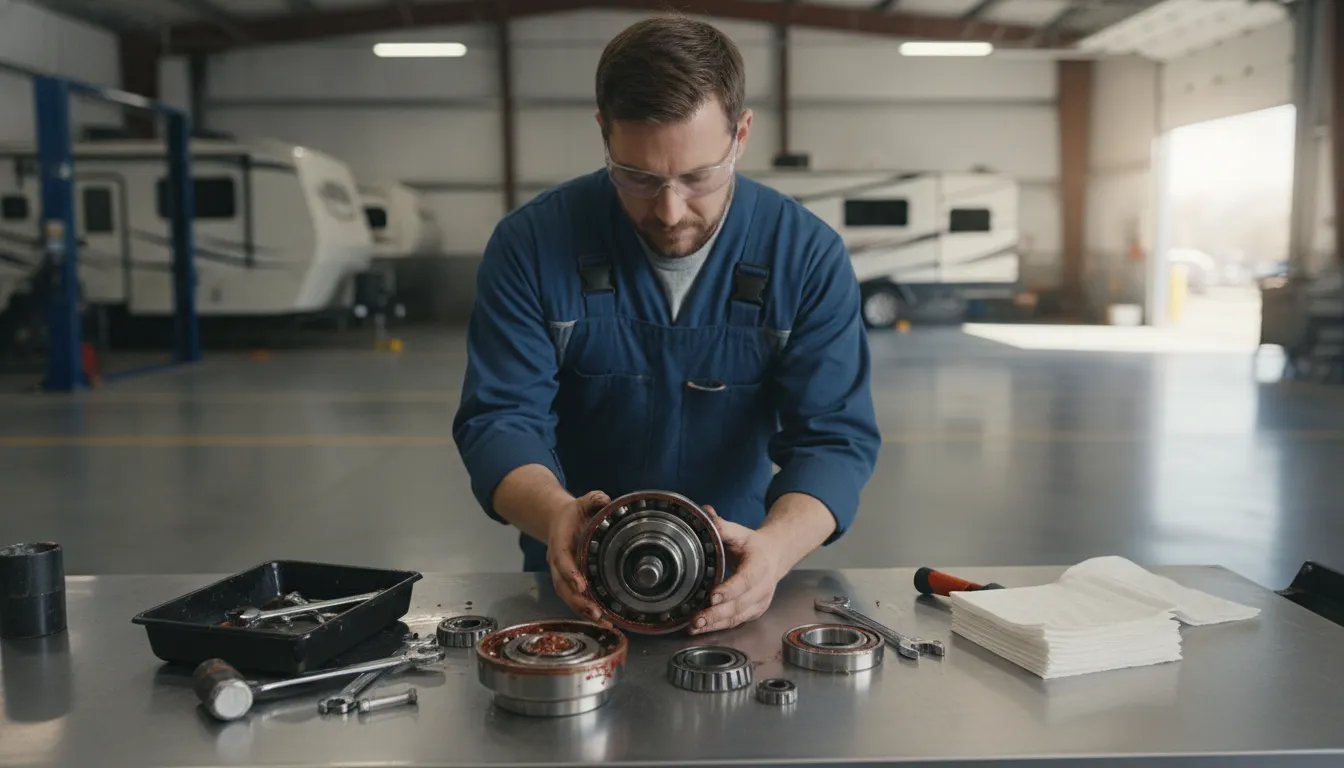
- Remove old grease and clean the parts. Old lubricant can hide metal debris, corrosion, scoring, or discoloration. Clean the bearing parts with an appropriate solvent and allow them to dry before inspection. Texas A&M AgriLife Extension maintenance guidance describes cleaning, inspection, and packing practices for trailer bearings.
- Inspect each cone and race. Check the rollers, cage, cone, and matching race for pitting, corrosion, scoring, unusual wear, and heat discoloration. A clean-looking cone does not make a damaged race safe to reuse.
- Check the spindle and seal. Examine the spindle surface where the bearing rides for wear, scoring, or damage. Check the seal for leakage, hardening, tearing, and other defects that could allow grease loss or contamination.
- Assess grease and brake components. Water, grit, metal particles, or burned lubricant can point to a larger problem. The hub is also an opportunity to notice brake contamination or related wear. If grease has reached the brake area, review the RV brake inspection and repair service.
- Document replacement and reassembly needs. Parts with pitting, corrosion, heat damage, or unsafe wear should not be returned to service simply because the trailer needs to travel soon. The correct replacement part must match the bearing, race, seal, and hub configuration.
Cleaning is not the same as inspection. A solvent can remove old grease, but it cannot make a scored race usable. The technician must examine the parts after cleaning and before packing. That distinction helps prevent a fresh layer of grease from hiding an existing failure.
Which Bearing Parts Need Close Inspection?
Every wheel end should be evaluated as a system. The cone contains the rollers, the race provides the matching surface, the seal protects the lubricant, and the spindle supports the assembly. Damage to one part can quickly affect the others, so replacing only the visibly worn piece may not be safe.
Cones and rollers
The cone and rollers should turn smoothly after cleaning. Look for pitting, flaking, scoring, rust, blue or dark heat marks, and an uneven wear pattern. A rough spot or discoloration deserves attention even when the bearing still turns by hand. A bearing can appear serviceable while its surface damage grows under load.
Races
The race is the matching surface pressed into the hub. Inspect it for grooves, pits, flaking, and heat marks. A new cone against a damaged race is not a complete repair. The cone and race should be treated as a matched working pair, and the replacement choice should follow the correct part numbers.
Seals and spindles
A seal that leaks can allow grease out and water or grit in. Inspect the seal lip, outer edge, and contact surface. The spindle should be free of deep scoring where the bearing rides. If a spindle is damaged, installing another bearing without correcting the support surface can lead to repeat problems.
Grease and brake areas
Healthy lubricant should not contain obvious water, metal particles, or burned residue. Grease on brake components can reduce braking performance and requires a separate brake evaluation. The general RV services and repairs page provides context for coordinating wheel-end work with other maintenance needs.
How Should Grease, Packing, and Seals Be Handled?
Use a high-temperature wheel-bearing grease approved for the specific axle and hub. Clean parts before packing, keep dirt and moisture away from the work area, and install a compatible seal correctly. The axle maker’s instructions control grease type, packing method, seal choice, and any limits on mixing products.
Grease selection is not a place to guess. Check the axle, hub, and bearing instructions before service. Different systems can specify different grease types or application methods. If the instructions prohibit mixing products, remove the old grease instead of adding a new product on top of it.
Cleanliness matters throughout the job. A clean bearing placed on a dirty work surface can pick up grit before it enters the hub. Use clean tools, protect parts from dust, and keep the new grease covered until it is needed. After packing, confirm that the bearing rollers and spaces are filled according to the applicable procedure.
The seal is part of the lubrication system, not a cosmetic add-on. A reused or incorrectly installed seal may leak soon after the repack. Press it evenly, avoid damaging the lip, and verify that the contact surface is clean and suitable. If the seal is hard, torn, distorted, or leaking, replace it with the correct part.
Do not assume that a grease fitting replaces a full inspection. Some hub systems are designed for a particular service method, but outside grease access does not show the condition of the inner cone, race, seal, or spindle. Follow the hub instructions and confirm what the fitting is designed to do before relying on it.
What Is the Difference Between Bearing Adjustment and Lug Torque?
Bearing adjustment sets the hub’s internal bearing play or preload. Lug torque secures the wheel to the hub. They are separate procedures with separate specifications. A wheel can have correctly torqued lug nuts while the bearing adjustment is wrong. So both steps must be completed with the axle maker’s instructions and a calibrated torque wrench.
After cleaning, inspection, packing, and seal installation, the hub must be reassembled and adjusted. The correct method can vary by axle and hub design. Some systems use a specific tightening sequence followed by backing off and retightening. Others use a different procedure. Use the actual service information rather than a generic number copied from another trailer.
Do not substitute wheel lug torque for bearing adjustment. Lug torque acts on the wheel fasteners. Bearing adjustment acts on the hub and bearing assembly. Confusing the two can leave a wheel end loose, overly tight, or improperly supported.
Use a calibrated torque wrench for the wheel fasteners and follow the wheel and axle specifications. Recheck the fasteners as directed after installation. The technician should also confirm that the hub turns as expected. The wheel has no unsafe play, and the brake components are correctly positioned before the RV is moved.
When a wheel end has been overheated, do not assume adjustment alone will solve the issue. Heat can damage the bearing, race, grease, seal, and spindle. The inspection findings determine whether a simple repack is appropriate or whether parts need replacement.
What Warning Signs Point to RV Wheel Bearing Failure?
Common warning signs include an unusually hot hub, grinding or humming, wheel play, vibration, grease leakage, smoke, or a wheel that does not rotate normally. A new symptom should be investigated before towing. If the hub is severely hot, smoking, loose, or noisy, stop and arrange a professional evaluation.
- Unusual heat: Compare wheel ends carefully after a short trip without touching a hot hub. One wheel end that is much hotter than the others deserves inspection.
- Noise: Grinding, humming, squealing, or a new rumble can indicate a bearing or related wheel-end problem. Noise that changes with speed should not be ignored.
- Wheel play: Movement at the wheel can indicate adjustment trouble, bearing wear, or another suspension and hub issue. Do not diagnose the cause from play alone.
- Grease leakage: Grease around the back of the hub, wheel, or brake area may indicate a seal problem or another failure that can contaminate brakes.
- Vibration or pulling: A change in trailer tracking, vibration, or braking can involve several systems. The wheel end, tire, brake, and suspension should be evaluated together.
- Smoke or a seized wheel: Treat smoke, a strong burnt smell, or a wheel that will not rotate as an urgent safety issue. Stop towing and seek help.
Do not use a brief drive as a substitute for inspection. A wheel-end problem can worsen quickly, and an exterior temperature check cannot show the condition of a race or spindle. If symptoms appear, secure the RV and avoid continuing the trip until the cause is understood.
For related stopping-system concerns, use the North Texas RV brake inspection resource. Brake contamination and bearing problems can occur together, but they require different checks and repairs.
Should You Repack RV Bearings Before a Long Trip?
Schedule an inspection before a long trip when the RV has reached 12,000 miles, a year has passed, the service history is missing, or warning signs are present. A pre-trip check can identify grease, seal, bearing, race, spindle, brake, and adjustment concerns before the trailer is far from home.
A long trip adds miles and heat to every wheel end. Before departure, review the last service date, axle instructions, tire condition, brake operation, and wheel-end symptoms. If the maintenance record is unclear, an inspection is more useful than assuming the bearings are ready.
Owners preparing for seasonal storage can also review the RV winter readiness service. Seasonal preparation does not replace wheel-end work, but it can help keep service records, tire checks, and pre-trip planning together.
After service, keep the date, mileage, parts replaced, grease used, and findings with the RV records. Note any follow-up recommendation. Good records make the next interval easier to plan and give the next technician useful information.
Patriots RV Services helps Denton and North Texas RV owners evaluate wheel-end maintenance alongside other RV service needs. The right scope depends on the axle, hub, service history, symptoms, and inspection findings. A professional can explain whether the RV needs a repack, replacement parts, brake work, or a broader evaluation.
Is DIY Repacking Right for Your RV?
DIY repacking may suit an experienced owner who has the correct axle information, safe support equipment, clean workspace, and time to inspect every part. Professional service is the safer choice when the axle is unfamiliar, history is missing, damage is visible, grease is contaminated, or brakes need evaluation.
An experienced owner with the correct service information, tools, clean work area, and time for a full inspection may be comfortable performing some bearing maintenance. The job is not just adding grease. It includes safe support, hub removal, cleaning, cone and race inspection, seal inspection, correct packing, adjustment, and wheel torque.
Professional service is the better choice when the axle is unfamiliar or the maintenance history is missing. It is also appropriate when the hub shows heat or pitting, grease is contaminated, or the brake assembly needs evaluation. Tandem and triple-axle trailers have more wheel ends and more opportunities for uneven wear or a missed problem.
A quick visual check cannot confirm the condition of parts inside the hub. If you cannot identify the correct bearing, race, seal, grease, adjustment procedure, or torque specifications, stop before disassembly and obtain the right service information.
Call Patriots RV Services at (940) 488-5047 to discuss an RV wheel bearing repack before you tow.
Frequently Asked Questions About RV Wheel Bearing Repack Service
How often should RV wheel bearings be repacked?
For many towable RVs, plan service every 12 months or 12,000 miles, whichever comes first. Use the axle and hub manufacturer’s instructions when they specify a different interval. Annual service remains important when an RV sits because grease ages and seals can deteriorate.
How do I know if my RV wheel bearings need service?
A hub that is much hotter than the others, new grinding or humming, wheel play, vibration, or grease leakage can indicate a wheel-end problem. Unknown maintenance history is also a reason to schedule an inspection before a long trip. Stop towing if a symptom is severe or worsening.
What grease is best for RV wheel bearings?
Use a high-temperature wheel-bearing grease approved for the specific axle and hub. The manufacturer’s instructions control the product and service method. Do not mix products or force grease through a fitting unless the hub is designed for that system.
Can I repack my own RV wheel bearings?
An experienced owner may be able to perform the work with the correct tools, service information, clean workspace, and safe support equipment. Professional service is a safer choice when the axle is unfamiliar, parts show heat or pitting, grease is contaminated, or brakes need inspection at the same time.
Schedule Your RV Wheel Bearing Service
Wheel-end maintenance is easier to manage when the interval, inspection findings, lubricant, parts, and adjustment are documented. Patriots RV Services can help you decide what your RV needs based on its axle, hub design, symptoms, and service history.