
When the dash vents in a diesel motorhome stop delivering cold air, the problem can affect comfort, visibility, and your ability to keep traveling through North Texas heat. Patriots RV Services helps diesel motorhome and Class A owners separate a true chassis air conditioning concern from a problem with the coach itself. The first distinction matters: dash or chassis AC cools the driver’s and front passenger’s compartment while driving. While rooftop or coach AC is designed to cool the living area when the motorhome is parked or connected to appropriate power.
For diesel RV chassis air conditioning repair, start with the symptoms and the system boundary, not a guess that the unit only needs refrigerant. A proper evaluation may consider airflow, controls, belts, the compressor, condenser, electrical components, and the refrigerant circuit. Patriots RV Services can help North Texas owners identify which system is involved and what diagnostic path makes sense.
Cooling that fades while driving, weak airflow, unusual noise or odor, suspected refrigerant leakage, or controls that do not respond can point to different parts of the system. Note when the symptom occurs, whether air is moving strongly, and whether the issue changes with engine speed before service. Those details give a technician a more useful starting point and help prevent unnecessary parts replacement.
Call Patriots RV Services at (940) 488-5047 to discuss your diesel motorhome AC concern.
Next, we will define what this repair category actually includes and why chassis and rooftop systems should not be diagnosed as if they were the same equipment.
What Diesel RV Chassis Air Conditioning Repair Actually Covers
When a diesel motorhome is uncomfortable on the road, the first question is which air conditioning system is failing. The chassis, or dash, system is the motor vehicle air conditioner that cools the driver’s and passenger’s compartment. It serves the cab while the coach is being driven. Patriots RV Services treats this work as distinct from air conditioning service for the living area. This keeps diagnosis focused on the system the driver is actually using.
That distinction matters because a rooftop or coach air conditioner conditions the living space, while chassis AC is connected to the vehicle’s driving-cab system. A roof unit may be working normally even when the dash vents are blowing warm air. The reverse can also be true. Turning on a rooftop unit, checking its thermostat, or replacing its filter does not diagnose a problem in the dash system.
The chassis and coach-builder boundary
Diesel motorhome dash AC can cross an equipment boundary. The chassis manufacturer may supply part of the installation, while the coach builder may supply or integrate another part. A Freightliner-based coach, for example, can involve chassis-related components and coach-builder sections in the same dash air conditioning installation. That is why the vehicle brand alone may not identify every part that needs to be inspected.
For the owner, this boundary explains why a chassis AC concern may require more than a general check of the coach interior. The technician needs to understand where the dash system begins, how the coach-builder portion connects to it, and which part of the vehicle is responsible for the symptom. Patriots RV Services provides diesel chassis air conditioning repairs as part of its diesel chassis service focus.
What the repair scope can include
The table below summarizes the system boundary.
| System. | Serves. | Check first. |
|---|---|---|
| Dash AC. | Driving cab. | Controls and airflow. |
| Rooftop AC. | Living area. | Power and thermostat. |
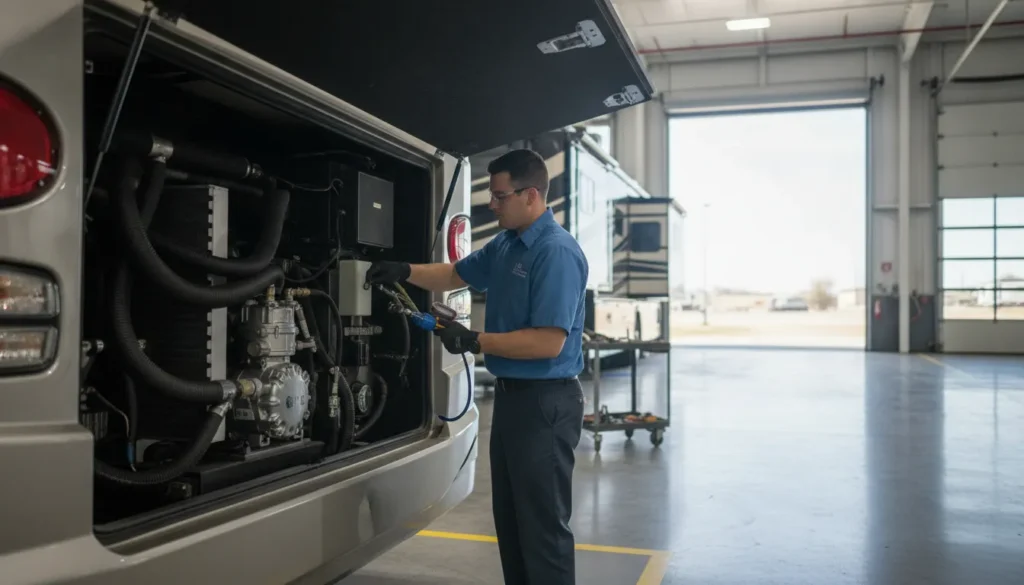
Diesel RV chassis air conditioning repair may involve the vehicle chassis or refrigerant circuit. It may also involve components that move and control air. Depending on the observed problem, the relevant inspection can include the compressor, condenser, blower, controls, belts, and electrical components. These parts do different jobs, so a symptom such as poor cooling does not identify a single failed component by itself.
The compressor and condenser belong to the cooling side of the system. The blower and controls affect air movement and the driver’s ability to select the desired operation. Belts and electrical components can also affect whether the system operates as intended. A complete diagnosis considers these areas together rather than assuming that adding refrigerant is the answer.
Patriots RV Services lists air conditioning and diesel chassis work as separate service categories, while recognizing that a diesel motorhome’s dash AC can involve both areas. That is the practical difference between chassis AC and coach AC. The system’s location, purpose, and installation boundary determine where the inspection starts. They also determine which components belong in the diagnostic path.
Why Does a Diesel Motorhome Dash AC Stop Cooling?
A dash AC that stops cooling can have more than one possible cause. The symptom helps narrow the inspection, but it does not prove that a particular part has failed. Patriots RV Services evaluates the chassis AC system as a connected group of controls, airflow components, belts, compressor, condenser, refrigerant circuit, and electrical parts.
Warm air while driving
If the vents blow warm air after the system worked normally, the fault may involve refrigerant flow. A control that is not directing air correctly, the compressor, or another part of the circuit. A suspected refrigerant leak deserves professional diagnosis rather than a simple assumption that the system only needs a recharge. A reported Freightliner case, for example, involved a leaking mixing valve. That is one documented example, not a universal diagnosis for every diesel motorhome.
Weak airflow from the vents
Air that feels cool but barely reaches the cab points the inspection in a different direction. The blower, controls, air passages, or related electrical components may need attention. Weak airflow can also make a cooling problem seem worse because less conditioned air reaches the driver and passenger compartment. Note whether every vent is affected and whether airflow changes when the fan setting changes.
Intermittent cooling
Cooling that comes and goes can be especially difficult to diagnose from a single observation. Record when it happens, including whether the failure appears only after driving for a while, during changes in engine speed, or when a control setting changes. Intermittent behavior may involve a control, electrical connection, compressor engagement, belt condition, or refrigerant-side issue. The pattern narrows the search, but it does not identify the failed component by itself.
Noise, odor, or signs of a leak
New squealing, grinding, rattling, or unusual odors should not be ignored, particularly when they appear with reduced cooling. Compressor or belt involvement warrants a closer inspection before continued operation creates additional damage. Visible wet or oily evidence near AC components can support a leak concern, but it cannot establish the source without appropriate testing. Another forum report described a plugged dryer that prevented refrigerant circulation. That report illustrates why the restriction point must be verified rather than guessed.
Electrical faults and control problems
If the fan, temperature controls, or compressor response do not behave as expected, an electrical fault may be part of the problem. Avoid jumping circuits or opening the refrigerant system. Professional diesel RV chassis air conditioning repair begins with the observed symptom and traces the system methodically, so the repair addresses the cause instead of replacing parts on speculation.
How Is a Chassis AC Problem Diagnosed?
A reliable diagnosis follows the system instead of guessing at the most visible symptom. Patriots RV Services approaches diesel chassis air conditioning repair as a sequence of checks that separates a control problem from an airflow restriction. Mechanical failure, refrigerant concern, or electrical fault. The exact tests depend on the chassis and system configuration, but the path generally looks like this:
- Document the symptom history. The technician starts by asking when the cooling problem occurs and what changed. Does the air stop cooling only while driving, or does it fail whenever the dash system is switched on? Is airflow strong but warm, or is very little air coming from the vents? Notes about unusual noises, odors, intermittent operation, recent service, or visible evidence of a leak can narrow the diagnostic path before components are accessed. Cooling failure while driving, weak airflow, unusual noises or odors. And suspected refrigerant leaks are all reasons to seek professional diagnosis, not to assume that adding refrigerant will solve the issue.
- Perform visual and access checks. The inspection then follows the chassis AC layout, including accessible hoses, fittings, the condenser area, compressor area, and related brackets or wiring. The technician looks for damage, contamination, loose connections, belt concerns, or other signs that point toward a component or installation issue. Diesel motorhome dash AC systems can involve both chassis-manufacturer and coach-builder sections, so access and system boundaries matter when deciding where to continue.
- Check controls and blower operation. The dash controls are tested through their available settings, including temperature selection, mode changes, and fan speeds. Blower performance helps distinguish a cabin airflow problem from a refrigeration problem. If the controls respond inconsistently or the blower does not operate as expected. The next checks may focus on the control circuit, switches, relays, connectors, or blower components rather than the compressor.
- Evaluate the belt, compressor, and condenser. The belt and compressor are inspected for involvement in the symptom, while the condenser is checked as part of the heat-release side of the system. A belt or compressor concern can affect cooling and may create noise or other mechanical clues. The condenser and surrounding airflow path also need to be considered before a refrigerant diagnosis is made. Patriots RV Services identifies the compressor, condenser, belts, blower, controls, and electrical parts as possible parts of a chassis AC diagnosis.
- Test the refrigerant circuit with proper equipment. If the evidence points to the refrigerant circuit, the technician evaluates that circuit for pressure behavior, leaks, restrictions, or other faults using appropriate recovery and diagnostic equipment. This is an overview of the process, not a DIY refrigerant procedure. Owners should not open the circuit, vent refrigerant, or treat an unverified charge level as a diagnosis. A refrigerant concern can be the result of a leak or restriction, and the underlying cause must be addressed before any recharge decision.
- Verify electrical operation and confirm the repair. Electrical testing can include the power, grounds, fuses, relays, connectors, sensors, and compressor-control signals relevant to the chassis. A fault in this area may prevent otherwise sound mechanical components from operating. Once the suspected repair is completed, the system is operated through its controls and checked for the original symptom, appropriate airflow, and stable cooling behavior. For Freightliner and other heavy-duty systems, Patriots RV Services uses diagnostic equipment for diesel chassis systems and identifies heavy-duty chassis work as a specialization. See the related RV AC repair services information for the broader service scope.
Call Patriots RV Services at (940) 488-5047 to discuss your chassis AC symptoms.
What Can an Owner Check Before Service?
A useful service visit starts with a clear symptom history. Before bringing the coach in, write down exactly when the dash air conditioning stops cooling. Does it fail as soon as the engine warms up, only at highway speed, or after the system has run for a while? Note whether the air becomes warm gradually or changes suddenly. If the problem is intermittent, record the outside temperature, engine temperature, driving conditions, and how long the system operated before the change.
Pay attention to airflow separately from temperature. A vent that blows strongly but delivers warm air suggests a different diagnostic path than a vent that barely moves air. Try each fan-speed setting and note whether the airflow changes. Check whether air comes from the selected dash vents, floor outlets, or defroster outlets. Do not remove panels to reach the blower or ducting. Simply recording what the controls do gives a technician useful information without disturbing the system.
Record control response, sounds, and odors
With the coach parked safely, observe how the controls respond. Does the blower switch on? Does the air direction change when you move the mode control? Does the compressor engage with a noticeable change in engine sound, or is there no apparent response? Avoid placing hands near belts, pulleys, fans, or other moving parts while the engine is running. If the controls, blower, or cooling response work only after repeated attempts, include that detail rather than assuming the part that needs replacement.
Listen for new rattling, squealing, grinding, clicking, or cycling sounds. Note when each sound occurs, such as at startup, during acceleration, or after the air conditioning has been running. A sharp chemical odor, burning smell, or musty odor is also worth reporting. Turn the system off and stop investigating if you notice smoke, a strong burning smell, or signs of an electrical problem.
Look, but do not disassemble
With the engine off and the coach cool, look for visible wet or oily residue around accessible hoses, fittings, or the compressor area. Photograph the location instead of wiping it away. You can also record recent repairs, belt work, battery or electrical work, refrigerant service, and any period when the coach sat unused. Include the chassis manufacturer and model year if known, plus whether the issue affects only the dash system or also the rooftop coach air conditioners.
These observations are preparation, not a diagnosis. Do not open the refrigerant circuit, disconnect lines, vent refrigerant, jumper electrical controls, or bypass high-current components. Owners without appropriate recovery and diagnostic equipment should seek professional service. Especially when cooling fails while driving. airflow is weak, or a leak, compressor, belt, or electrical fault is suspected. For preventive guidance, review North Texas RV AC maintenance information, then provide your notes and photos to the technician.
When Do Refrigerant Rules Make Professional Service Necessary?
Refrigerant handling is one of the clearest points where diesel RV chassis air conditioning repair should move from owner troubleshooting to qualified service. Dash air conditioning is a motor vehicle air conditioning, or MVAC, system. It is regulated differently from a simple cabin fan or a rooftop coach unit. And the rules apply even when the repair is performed on a large motorhome rather than a passenger car.
Paid MVAC work requires Section 609 certification
Under Section 609 of the Clean Air Act, anyone who repairs or services an MVAC system for payment must be trained and certified through an EPA-approved program. The requirement applies regardless of which refrigerant the system uses. The EPA explains the certification requirement in its MVAC servicing regulations. That makes refrigerant-related dash AC work a professional-service issue, not simply a matter of adding refrigerant after a system stops cooling.
Certification is only one part of compliant service. The technician also needs equipment approved for refrigerant handling. The EPA states that Section 609 requires certified refrigerant-handling equipment, either certified by the EPA or by an approved independent standards testing organization. The agency’s certified MVAC equipment guidance explains this requirement. Appropriate equipment supports controlled recovery and helps prevent the release of refrigerant during diagnosis or repair.
Recovery comes before repairs that may open the system
If a repair or another vehicle service could reasonably be expected to discharge refrigerant, certified servicing equipment must be used to remove it before work begins. This matters when access requires disconnecting a hose, replacing a component, or opening the circuit. The correct sequence is to assess the repair, recover refrigerant with certified equipment when discharge could occur, and then proceed with mechanical work.
Recovered refrigerant cannot simply be poured back into the system without preparation. Before it is recharged into an MVAC system, it must be recycled or reclaimed. The rule still applies if the refrigerant is going back into the same vehicle from which it was removed. That process helps keep contaminants from being returned to the circuit and keeps service within the EPA’s handling requirements.
Intentional venting is not an acceptable shortcut
EPA-approved refrigerant cannot be intentionally released, or vented, into the environment. Owners should not attempt to bleed refrigerant from a dash AC system, and they should not ask a shop to bypass recovery procedures. If a leak is suspected, stop short of opening the circuit and arrange an evaluation by a provider equipped for compliant MVAC service. For broader background, the EPA’s MVAC overview summarizes the purpose and regulatory framework for these systems.
These rules do not identify a particular company as certified, so Patriots RV Services’ qualifications should be confirmed directly when scheduling service. The practical takeaway is simple: suspected refrigerant loss, a component replacement. Or any repair that may discharge the circuit calls for proper equipment, trained service, and recovery procedures rather than a DIY recharge.
Where Can North Texas Owners Get Diesel Chassis AC Help?
For diesel motorhome owners in Denton and North Texas, Patriots RV Services provides a fixed service destination for chassis air conditioning concerns. The facility is located at 11399 US-380 W in Krum, west of Denton, with direct access to US-380 and convenient proximity to I-35E and I-35W. That location can be practical for owners whose dash AC has stopped cooling during a trip. As well as for local owners who want a proper evaluation before a small symptom becomes a larger repair.
Chassis AC work on a diesel coach is not always a simple recharge. The system may involve the vehicle chassis, compressor, condenser, blower, controls, belts, electrical components, and refrigerant circuit. Patriots RV Services identifies diesel chassis systems, including Freightliner and other heavy-duty platforms, as a technical specialization. Its team also uses diagnostic equipment for diesel chassis systems, supporting a more methodical assessment of where the fault may be located. Equipment does not replace good troubleshooting, but it can help the technician evaluate the system rather than guess at a part.
The facility is set up for more than compact vehicles. Patriots RV Services reports more than 30 service bays and heavy-duty equipment for RVs of many sizes. That includes large Class A motorhomes and other heavy coaches, with documented capacity for a 43-foot toy hauler and a heavy-duty forklift rated for vehicles over 20,000 pounds. Owners should still confirm that their specific coach and requested work can be accommodated. But a large diesel motorhome does not automatically have to be treated like an ordinary passenger vehicle.
The service area extends beyond Krum and Denton County. Patriots RV Services serves broader North Texas, along with RV owners from Oklahoma and Arkansas who need diesel chassis, air conditioning, and related repair expertise. For travelers moving through the region on US-380, I-35E, or I-35W. The Krum facility offers a clear place to discuss a chassis AC problem with a shop familiar with large RV systems.
How a shop communicates matters as much as where it is located. Patriots RV Services is veteran-owned and operated and states that it emphasizes honest assessments, transparent pricing, no upselling, and attention to details that can prevent larger problems. The company also reports more than 45 years of combined team experience. Those statements are a service approach, not a promise that every repair will be immediate or inexpensive. A sound first step is to describe the symptoms, explain when the cooling changed, and ask what the diagnostic process will cover.
If your diesel coach has weak or absent dash cooling, unusual AC-related noise, or an issue that returns after a temporary fix, gather your observations. Then reach out before continuing to replace parts on speculation.
Contact Patriots RV Services to discuss your diesel chassis AC needs, or call (940) 488-5047.
Frequently Asked Questions
Can diesel RV chassis air conditioning be repaired?
Yes. Many dash AC problems can be diagnosed and repaired, but the correct repair depends on the failed component. The system may involve controls, blower parts, belts, compressor, condenser, refrigerant lines, or electrical components. A proper diagnosis should identify the cause before parts are replaced.
What are common signs of a diesel motorhome dash AC problem?
Common signs include warm air while driving, weak or absent airflow, cooling that works intermittently, unusual noises, unusual odors, or visible evidence of a possible leak. Note when the symptom occurs and whether the fan and temperature controls respond. Those details help narrow the diagnostic path.
What does the cost of chassis AC repair depend on?
Repair cost depends on the diagnosis, the component involved, access to the part, required refrigerant service, and the time needed to verify the repair. A control or electrical issue may require a different scope than a compressor, hose, condenser, or leak-related repair. An inspection provides a more useful estimate than guessing from the symptom alone.
How is chassis AC different from rooftop coach AC?
Chassis AC, also called dash or motor vehicle AC, cools the driver and passenger compartment while the motorhome is traveling. Rooftop coach AC is part of the living-area climate system and is designed to cool the coach interior, typically when connected to an appropriate power source. The systems use different components and should be diagnosed separately.
Can I service the refrigerant myself?
Refrigerant service requires the proper recovery and handling equipment. The EPA requires Section 609 certification for paid MVAC service, and refrigerant cannot be intentionally vented. Source: EPA MVAC servicing requirements.
Schedule the Next Step for Your Diesel RV
If your diesel motorhome dash AC is not cooling as expected. A clear diagnosis can help separate a chassis system concern from a problem with the coach, controls, airflow, or refrigerant circuit. Patriots RV Services can discuss your symptoms, your travel area, and the appropriate next step for diesel RV chassis air conditioning repair in Denton and North Texas. Before reaching out, note when the cooling changed, whether airflow remains strong, and whether you noticed unusual noise or odor.
Contact Patriots RV Services to schedule professional diagnosis, or call (940) 488-5047 to speak with the team about your diesel RV AC concerns.