
When an RV component is discontinued, damaged beyond repair, or no longer supported by the manufacturer. The search for a replacement can stop a project before the real diagnosis begins. The original part, its mounting points, and the surrounding assembly may still provide the information needed to build a reliable solution.
For owners in Denton and across North Texas, custom RV parts fabrication at Patriots RV Services starts with careful assessment, precise measurement, and material selection. Machining or fabrication follows. The finished component is checked for fit, function, and finish instead of treated as a one-size-fits-all replacement.
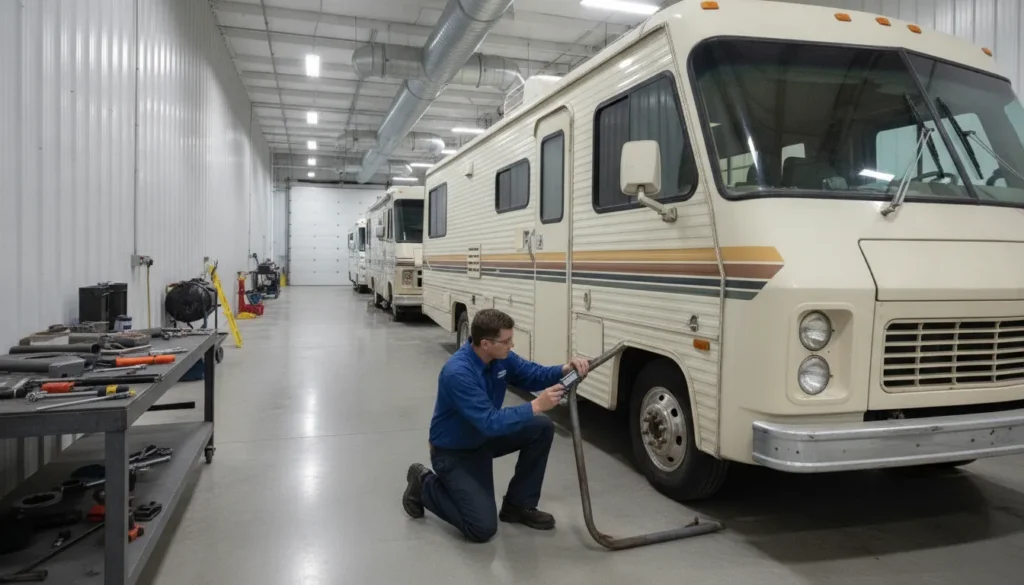
Patriots RV Services evaluates specialized work at its climate-controlled Krum facility near Denton, using high-precision equipment and CNC machining where appropriate. Contact Patriots RV Services at (940) 488-5047 to discuss the component and bring the details that can help technicians determine the right path. First, it helps to identify which parts are realistic candidates for fabrication and which require a different repair strategy.
What Parts Make Good Candidates for Custom Fabrication?
Custom fabrication is most useful when a replacement part is no longer a straightforward catalog purchase. Older and high-end RVs can depend on brackets, covers, supports, trim pieces, mounts, and other components that a manufacturer no longer produces. Patriots RV Services evaluates these situations at its Krum facility near Denton, where specialized equipment supports high-precision metal and component work.
An obsolete part is a strong candidate when its original design is known, its mounting points can be documented, and the surrounding assembly remains serviceable. A discontinued component may also be worth evaluating when searching for a used replacement has produced inconsistent results or when an available substitute would require compromising the original fit. That does not mean every part can be reproduced. The technician must first determine what the component does, how it carries loads, and how it interacts with adjacent parts.
Damaged parts can reveal what needs to be rebuilt
A damaged original can still be valuable, even when it is bent, cracked, corroded, or partially broken. It may preserve critical information about hole locations, clearances, bends, fasteners, and the way the part was installed. Bring the original whenever possible, along with mating hardware, photos, dimensions, and identifying information. Those details help separate damage caused by an isolated incident from a design, alignment, or fitment problem that could affect the replacement.
In some cases, repair is more appropriate than fabrication. A repair may preserve a sound component when the damage is limited and the material can be restored reliably. Fabrication becomes more relevant when the original is beyond practical repair, unavailable from the manufacturer, or no longer addresses the way the assembly needs to function. The decision should follow inspection rather than a blanket rule.
Cosmetic and safety-critical boundaries matter
Cosmetic pieces, exterior covers, decorative trim, and finish-matched components can be good fabrication candidates when appearance and fit are the primary concerns. Exterior work may require coordinated paint or body attention, so Patriots RV Services can evaluate fabrication alongside RV paint and body repair when appropriate.
Safety-critical parts require a higher level of caution. Structural supports, suspension components, braking hardware, propane-system parts, and other load-bearing or life-safety components should not be treated as ordinary replacement projects. Their material, dimensions, attachment method, and operating loads must be assessed by a qualified technician. Custom work is not automatically safer, less expensive, or faster than a factory replacement. It is a solution to evaluate when the evidence supports it.
For owners in Denton or across North Texas, the right first step is a documented assessment of the part and its complete assembly.
Contact Patriots RV Services at (940) 488-5047 to discuss custom RV parts fabrication.
How Custom RV Parts Fabrication Begins With Assessment
Custom RV parts fabrication should begin with a careful assessment, not a guess based on a photograph or a universal replacement part. At Patriots RV Services, the first objective is to understand what failed. How the component fits into the larger assembly, and what the finished part must do in service. That evaluation is especially important when an original component is obsolete, discontinued, or damaged beyond practical repair.
Inspection starts with the part itself and the area around it. Technicians look for cracks, distortion, wear patterns, corrosion, heat damage, movement, and signs that an earlier repair changed the fit. A component can appear to be the problem while the actual cause is a shifted mounting point. A worn fastener, a damaged bracket, or stress from an adjoining assembly. Examining the surrounding structure helps define the repair correctly and prevents a new part from repeating the same failure.
Documentation gives the assessment a reliable reference. If possible, preserve the original part, even when it is broken. Bring all mating hardware, fasteners, brackets, spacers, and related pieces with it. Clear photographs of the installed position are useful, particularly when they show the orientation, attachment points, and nearby components. Manufacturer names, model numbers, serial numbers, casting marks, labels, and other identifying information can also help establish the original design and intended fitment.
Measurements then turn the inspection into a workable specification. Important details may include overall length and width, thickness, hole spacing, hole diameter, bends, angles, clearances, and the position of mating surfaces. Measurements should be taken from stable reference points and checked against the surrounding assembly. A small error at one mounting surface can create binding, uneven loading, or interference elsewhere. When the original is distorted. Technicians may need to compare it with the vehicle and unaffected portions of the assembly rather than treating its damaged shape as the correct template.
Project scope is defined only after these details are understood. The solution may involve a replacement component, a redesigned interface, precision machining, fabrication, or additional repair to the mounting area. Material selection and finishing requirements are also considered according to the part’s load, exposure, movement, and contact with neighboring materials. Patriots RV Services performs this type of evaluation in its climate-controlled Krum facility near Denton, using specialized equipment for high-precision custom metal and component fabrication.
For a specialized project, bring the available parts and identifying information before assumptions narrow the options.
How Do Technicians Measure and Reverse-Engineer a Damaged Part?
A broken original is still valuable evidence. Even when a component cannot be reused, its shape, wear patterns, mounting points, and relationship to nearby parts can show how the replacement must function. Careful reverse-engineering is not guesswork or simply copying the most visible portion. It is a controlled process that accounts for the complete assembly and the conditions the part must withstand.
At Patriots RV Services, CNC machining and high-grade materials support custom RV parts fabrication for components that are damaged, obsolete, or no longer supported by the manufacturer. Owners in Denton and across North Texas can help the evaluation by preserving the original and bringing the surrounding hardware when possible.
- Preserve the original. Do not discard a cracked, bent, or partially broken component before it is evaluated. Keep every fragment, fastener, spacer, washer, bracket, and related piece together. A break can reveal the direction of force, while a worn surface can identify where movement or contact occurred. If the part must be removed, protect the pieces from additional bending, corrosion, or loss.
- Document orientation and installation. Take clear photos before disassembly, including the part from several angles and its position in the RV. Mark which side faces outward, upward, forward, or toward the interior. Note cable paths, hinge directions, clearance areas, and any shims or washers. A component that looks symmetrical on a workbench may have a precise orientation once installed.
- Identify every mating surface. The replacement must connect correctly to the parts around it. Technicians examine bolt holes, threads, pivots, rails, slots, welded joints, seals, mounting flanges, and contact surfaces. They also inspect the surrounding assembly for distortion or wear. Reproducing a damaged part without checking what it mates with can reproduce the original problem or create a new fitment issue.
- Measure the usable evidence. Measurements are taken from intact edges and reference points, then compared across the original fragments and the installation area. Thickness, hole spacing, angles, radii, clearances, and alignment all matter. When a section is missing, the mating hardware and undamaged surrounding surfaces help establish the intended dimensions. Photos, identification numbers, and owner-supplied dimensions can add useful context, but they do not replace a hands-on evaluation.
- Check the proposed fit before final production. A design is reviewed against the mounting points, movement range, load path, and available clearance. Depending on the component, the process may include a template, test piece, or controlled trial fit. Adjustments are made before the final part is committed, especially where a small dimensional error could cause binding, uneven loading, or premature wear.
- Confirm the design and intended use. The final review considers whether the new component performs its intended function and works with the existing assembly. Material, attachment method, exposure, and service conditions are part of that decision. Safety-critical assemblies require evaluation by qualified professionals before fabrication or installation. This includes parts connected to structural support, suspension, braking, propane, or other systems where failure could create a serious hazard.
This sequence gives a fabrication project a defensible starting point. It also helps determine when a damaged part should be repaired, redesigned, or replaced through another solution. Specialized work varies by component, so the right next step is an evaluation of the original and the system around it.
Contact Patriots RV Services for custom RV parts fabrication and call (940) 488-5047.
How Material Selection Affects Fit and Durability
A replacement component can look correct and still fail if its material does not suit the way the RV uses it. Material selection is application-specific. The right choice depends on the part’s job, the loads it carries, the environment around it, and how it connects to the rest of the assembly. A material that works well for a protected interior bracket may be a poor fit for an exterior component exposed to water. Road debris, temperature changes, and repeated movement.
During custom RV parts fabrication, Patriots RV Services evaluates the complete application rather than choosing a material by habit. The original part, when available, can provide useful clues, but it is not the only reference. A damaged original may have distorted over time, or the replacement may need to account for changes in the surrounding hardware. High-grade materials and precision equipment support the process, but the material still has to match the specific duty of the finished component.
| Decision factor | Questions to evaluate | Why it affects the result |
|---|---|---|
| Load | Does the part carry weight, resist tension, guide movement, or maintain alignment? | The material must handle the part’s working forces without unacceptable flexing, deformation, or premature wear. |
| Exposure | Will it face moisture, road spray, heat, sunlight, chemicals, or changing temperatures? | Environmental conditions influence corrosion resistance, dimensional stability, surface protection, and service life. |
| Movement | Is the component stationary, hinged, sliding, vibrating, or repeatedly cycled? | Movement changes friction, wear, clearances, and the need for strength or flexibility at contact points. |
| Mounting | How is the part fastened, and where do fasteners, welds, bearings, or inserts transfer force? | Mounting details affect local stress, hole durability, fit tolerance, and the way the component can be fabricated. |
| Surrounding materials | What materials touch the component, and how do their surfaces and expansion rates interact? | Compatibility can affect galvanic corrosion, wear, sealing, noise, and whether the completed assembly stays properly aligned. |
These considerations also help determine whether the finished part needs machining, shaping, reinforcement, surface treatment, or another fabrication step. Fit is not merely a matter of matching an outline. It includes the relationship between the component, its fasteners, mating surfaces, and operating clearances. A careful assessment reduces the risk of producing a part that fits at rest but binds, shifts, or wears quickly in use.
Contact Patriots RV Services to discuss your RV fabrication project and call (940) 488-5047.
Bring the original component if possible, along with its mating hardware, clear photos, and any identifying information. Patriots RV Services can evaluate the application at its climate-controlled Krum facility near Denton and determine which material and fabrication path fit the project.
What Happens During Fabrication, Fitment, and Finish Matching?
Once the part has been assessed and the design is understood, fabrication moves from measurement to controlled production. The exact sequence depends on the component, the condition of the original, and how the part interacts with the surrounding assembly. Patriots RV Services may use precision machining, shaping. And other fabrication methods to reproduce an obsolete or unsupported RV component while preserving the fit and function the installation requires.
Machining is used when the design calls for accurate dimensions, repeatable edges, or carefully positioned mounting points. CNC machining and high-grade materials are part of the shop’s capabilities for reverse-engineering components that manufacturers no longer support. Other parts may require cutting, bending, forming, welding, or hand finishing. These methods are not selected for appearance alone. The technician considers how the part carries load, moves, seals, mounts, and responds to the environment around it.
Trial fit reveals what a workbench cannot
A fabricated part is not finished simply because it matches a drawing or measurement. The technician places it into the actual assembly for a trial fit, checking mating surfaces, fastener locations, clearances, alignment, and movement. Surrounding components can shift, wear, or deform over time, so the original dimensions may not tell the complete story. Trial fitting helps identify interference or gaps before final finishing and installation.
Adjustments may include refining an edge, correcting a mounting position, changing a bend, adding clearance, or modifying a contact surface. This step is particularly important for moving assemblies, access panels, brackets, and parts exposed to vibration. A climate-controlled facility with specialized equipment supports the controlled work required for high-precision custom metal and component fabrication, but each project still requires its own evaluation.
Exposure and finish are part of the fit
Exterior components must withstand conditions such as moisture, road spray, sunlight, temperature changes, and contact with dissimilar surrounding materials. Those exposure factors influence the final preparation and protection. Interior parts may have different concerns, including repeated handling, cleaning, flexing, or contact with adjacent trim. The goal is not to assume one finish works for every application, but to match the finish to the part’s location and use.
When a component is visible, finish matching also matters. Surface preparation, texture, color, and sheen can affect whether the new work blends into the coach or draws attention as a replacement. For exterior damage or color coordination, Patriots RV Services also handles RV paint and body repair. That work can be considered alongside fabrication when the project includes damaged panels or surrounding surfaces.
Before work begins, bring the original part when possible, along with mating hardware, photos, dimensions, and identifying information. That documentation gives the shop more context for the trial fit and helps determine whether additional adjustment or a related repair is needed.
When Should You Fabricate, Repair, or Keep Searching?
The right answer depends on what failed, what remains usable, and whether an available replacement will actually solve the fitment problem. Start with the original part and the surrounding assembly, not with the assumption that fabrication is automatically the best option.
Choose fabrication when the part is obsolete or no longer supported
Custom RV parts fabrication is worth evaluating when a manufacturer has discontinued the component, the factory replacement cannot be sourced, or the original design is no longer supported. It can also make sense when a damaged part is beyond practical repair, yet the surrounding hardware, mounting points, and system are still viable.
Patriots RV Services uses CNC machining, high-grade materials, and specialized equipment to reverse-engineer or fabricate certain unsupported components. That does not mean every part can be reproduced. A proper assessment determines whether the geometry, material, load, and installation requirements can be addressed responsibly.
Fabrication may be especially useful for owners of older or high-end rigs, where a small missing component can keep an otherwise serviceable coach off the road. Bring the original part if available, along with mating hardware, photos, identifying information, and any measurements. Those details help technicians distinguish a one-off fabrication project from a larger assembly problem.
Choose repair when the original part can be restored correctly
Repair is often the better path when the damaged component can be returned to reliable service without compromising its fit, strength, movement, or finish. A repair evaluation should include the cause of failure. For example, reinforcing a cracked mounting point without correcting misalignment may only repeat the same failure. If the issue involves delaminated fiberglass or another structural RV component, review the dedicated structural RV component repair guidance and have the damage evaluated before selecting a solution.
Keep searching when an approved replacement is available
Continuing to search may be sensible when an exact, properly specified replacement is still available and its compatibility can be confirmed. The goal is not to replace a known, supported solution with a custom part simply because fabrication is possible. Confirm dimensions, mounting pattern, material, operating clearances, and compatibility with the rest of the system before ordering anything.
Use extra caution with structural, suspension, braking, propane, electrical, and other safety-critical systems. A fabricated component in one of these areas requires professional inspection and validation. Do not rely on appearance alone, and do not install an unverified part because the RV is urgently needed for travel.
For owners in Denton and across North Texas, Patriots RV Services can evaluate the part and the surrounding system at its climate-controlled Krum facility, just outside Denton. Specialized projects require an honest assessment of scope, materials, and fitment before the next step is chosen.
Contact Patriots RV Services to discuss your part and call (940) 488-5047.
Frequently Asked Questions
What is involved in custom RV parts fabrication?
The process starts with inspecting the damaged, obsolete, or discontinued component and the surrounding assembly. Technicians document dimensions, mounting points, movement, load, and exposure. They then select a suitable material, reverse-engineer the part as needed, and use precision machining or fabrication to produce a replacement. Fitment testing and finish work follow before the component is considered complete.
When should I consider custom-fabricated RV parts over replacement?
Consider an evaluation when the factory part is no longer supported, cannot be sourced, or is damaged beyond practical repair. Fabrication may also address an underlying fit or design problem that simply installing another replacement would leave unresolved. The correct choice depends on the part and its function, so safety-critical components require careful inspection before any fabrication decision.
How do I measure for a custom RV part if the original is broken?
Preserve the original rather than discarding it, even if it is damaged. Bring the part, mating hardware, photos, dimensions, and identifying information for evaluation. The surrounding mounting surfaces and adjacent components can provide essential reference points when the original no longer gives a complete template.
What materials are best for custom-fabricated RV parts?
There is no universal best material. Selection should account for the part’s load, movement, moisture and temperature exposure, mounting method, and contact with surrounding materials. Patriots RV Services uses high-grade materials and evaluates the application before choosing a material that supports the required fit and service conditions.
Can a custom part match my RV’s original finish?
Finish matching can be part of the project after the component has been fabricated and fit-tested. The required approach depends on whether the part is interior or exterior and whether it needs a particular texture, coating, color, or corrosion-resistant finish. Exterior damage and paint considerations may also require coordinated RV paint and body repair.
Contact Us to Evaluate Your RV Component
When an obsolete, discontinued, or damaged component cannot be sourced, a careful assessment can clarify whether fabrication is a practical path and what the project requires. Patriots RV Services can discuss the part, its fitment, and the surrounding assembly with RV owners in Denton and across North Texas.
Contact Patriots RV Services to arrange an assessment at the Krum facility near Denton, or call (940) 488-5047 to discuss your component and next steps.