

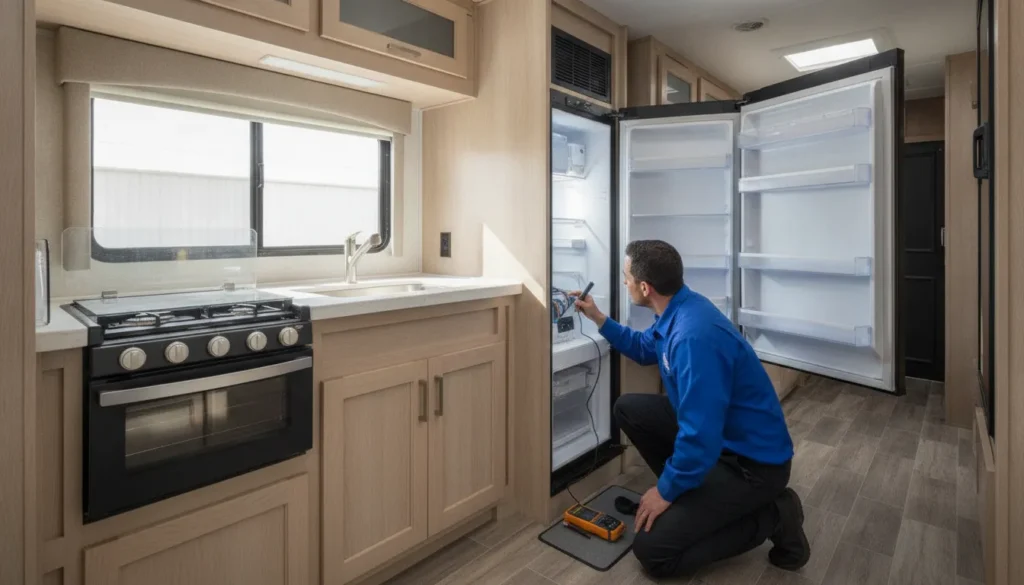
An RV refrigerator often stops cooling if the vehicle sits just three degrees off level. This small shift can trap heat and stop the cooling cycle before it even starts.
RV refrigerator not cooling issues usually stem from a lack of air, power failures, or an unlevel rig. Absorption fridges rely on gravity to move cooling fluids. Being even slightly off-level can stop the whole process. You should check that your propane is on and that your battery is a reliable 12V power source for your refrigerator. It is also vital to keep your rig level. Fluids cannot flow well if the unit is more than three degrees off side-to-side, according to The RV Surplus. Checking the vents for dirt and making sure you have the right power settings often solves the problem. If these simple steps do not work, you may have a bad cooling unit or a leak.
Fixing a warm fridge starts with a look at how these systems work. You need to know which parts to check first so you can save your food and your trip. Why is your RV refrigerator not cooling? The answer begins with these simple checks.
Why is your RV refrigerator not cooling?
A warm fridge can ruin a great trip. When you find your RV refrigerator not cooling, it is hard to know where to start. You might have a simple power issue or a major part failure. Finding the cause fast helps save your food and your mood.
Look for power source failures
Most RV fridges use three power modes. These are gas, AC power, and DC battery power. If the unit fails in only one mode, the fix might be easy. A blown fuse or a clogged burner are common spots for trouble. But if it fails in every mode, you likely have a deeper problem in the cooling unit.
You must have a reliable 12V power source for your refrigerator to run its control board. Even when using propane, the fridge needs battery power to stay on. Check your battery levels and shore power cord before you worry about a full part swap. Look at the back of the fridge for any yellow stains. This dust is a sign of a leak and means the unit is dead.
Verify your leveling status
RV fridges work through heat and gravity. They do not use a pump like the one in your home. Instead, they use a mix of fluids that must flow through narrow tubes. If your RV is not level, these fluids can pool and block the system. This can lead to bad damage if you do not catch it early.
For your unit to work well, the RV must be nearly level. Limits for most units are about three degrees from side to side and six degrees from front to back. Proper temperature checks are a key part of saving any cold storage supply from loss. A small tilt is all it takes to stop the cooling process. If you have been off level for a long time, turn the unit off for a full day to let things settle.
Test the cooling unit speed
A healthy fridge takes time to get cold. In most cases, you should feel the bottom of the freezer section start to get cold within six to eight hours. If the freezer is cold but the lower fridge is warm, your vent or fan might be blocked. This is a common sign of poor air flow in the back of the unit.
Hot weather can also slow things down. When outside heat goes over 90 degrees, the fridge has a harder time shedding heat. You may need to add a small fan to the back vent to help it breathe. If your fridge still stays warm after a day, you need an expert. Handling these units involves strict rules for chemicals. Federal laws like 40 CFR 82.150 cover how to service tools that use cooling fluids. Our team can provide professional RV diagnostic and repair services to find the root cause.
Start with a safe power-source check
When you notice your RV refrigerator not cooling, do not panic. The fix may be as simple as a flipped switch or a loose plug. Most RV fridges are complex units. They often use more than one source of fuel to keep things cold. If the power source fails, the cooling cycle stops. You must check these links first to save time and money. This helps you find the root cause before you seek an expert repair.
Understand your fridge power modes
Modern RV units usually run on three types of power. These are 12V DC battery power, 120V AC shore power, and propane gas. Your fridge needs a reliable 12V power source for your refrigerator to work at all. This low-voltage power runs the control board. Even if you use gas, a dead battery will keep the fridge from starting. Most owners in North Texas find that battery issues are a top cause for cooling failure.
Shore power is what you use when you plug into a camp site. It powers the electric heating element. If this part fails or loses power, the fridge will not stay cold. Propane is your best bet when you go off-grid. It uses a small flame to heat the unit. You should know which mode your fridge is in before you start your check. Knowing how the power flows is a mission-critical skill for any RV owner.
Follow these power check steps
- Check the 12V house battery. Look at your monitor panel to make sure the battery has a full charge. A weak battery may have enough juice for lights but not enough to trigger the fridge gas valve or control board.
- Test the shore power link. Unplug the fridge from its outlet in the outside vent area. Plug in a small tool or light to see if the outlet has power. If it does not, check your main breaker panel inside the RV.
- Check the fuses and breakers. Find your RV power center. Look for a blown 12V fuse or a tripped 120V breaker labeled for the fridge. Replace any bad fuses with the same amp rating.
- Check the propane supply and flame. Make sure your gas tanks are full and the valves are open. Try to light a stove burner to purge air from the lines. Then, listen for the fridge igniter to click and see if the flame stays lit.
- Read the error codes on the display. Many new fridges will show a code like “LP” or “AC” when they fail to start. Use your owner’s manual to find what these codes mean for your specific brand.
Keep your food and family safe
Steady power is not just about comfort. It is about safety. Just as the CDC monitors cold storage for health needs, you must keep your fridge at the right temp. For food safety, the main fridge area should stay below 42 degrees. If you cannot get the power back on, your food will spoil fast. If these steps do not work, you may have a bad cooling unit or a leak.
Do not try to fix gas lines or cooling coils on your own. These systems use high pressure and can be dangerous. If your power is fine but the fridge is still warm, it is time for a pro. Our team in Denton can run a full check to find the fault. We help you get back on the road with a fridge you can trust. This keeps your trip on track and your food safe.
Check leveling, ventilation, and airflow
Most RVs use absorption fridges. These units do not have a motor or a pump. Instead, they use heat to move a mix of ammonia and water. For this to work, your RV must be close to level. If the RV sits at a steep angle, the fluid can get stuck. This can cause a blockage that ruins the cooling unit. If you find your RV refrigerator not cooling, check your level first.
Keep the unit level
To keep the fluids moving, your RV should be level within small limits. It needs to be within about three degrees side-to-side and six degrees front-to-back. If you stay in a spot that is too slanted, turn the fridge off. If you ran it while off-level for a long time, turn it off for 24 hours. This lets the fluids settle before you try to start it again. Once you are level, give it four to six hours to reach the right safe storage temperature.
Boost exterior airflow
Your fridge needs to get rid of heat to stay cold. In the North Texas heat, this is a big task. When the air outside is above 90 degrees, it is hard for the unit to shed heat. You should check the vent on the outside of your RV. Look for bird nests, wasp hives, or leaves that block the path. If air cannot flow over the back of the fridge, the inside will get warm. Keeping the vent clear is a simple way to help your fridge work better.
Inspect vents safely
You can do a visual check of your vents from the outside. Look through the slats for any clear blocks. But you should not take parts of the unit apart. The cooling system is under pressure and holds chemicals. Only pros should handle deep repairs or part changes. If a basic cleaning of the vent does not help, you may need professional RV diagnostic and repair services. Our team in Denton can find the root cause of your cooling issue fast.
Inspect the refrigerator interior
When your RV refrigerator is not cooling, look inside for clues. You should start by checking the state of the fridge and how you pack your food. Small issues often lead to big cooling failures. Checking these items first can save you time and money on repairs.
Do not assume the cooling unit is broken until you scan the box. Many simple fixes start right inside the door. You should look for air leaks and blockages before you call for help.
Check door seals and frost buildup
A bad door seal is a common cause for a fridge failure. You may need expert RV repair services if you cannot find the leak. If the seal is loose or torn, warm air will move inside. This makes the cooling unit work too hard and leads to warm food.
You can test the seal by closing the door on a dollar bill. If the bill pulls out, the seal is not tight enough. Also, look for thick frost on the cooling fins. Too much frost acts as a blanket that stops cold air from moving. Defrost the unit if you see ice thicker than a quarter inch.
Proper packing and airflow
RV fridges do not mostly have fans like the unit in your house. They rely on the flow of air to move cold from the back to the front. If you pack too much on the shelves, you block this air. This will leave some areas warm while others stay cold.
Keep items at least an inch away from the walls. You should also look at the thermistor. This is a small sensor clipped to the cooling fins. Ensure it is in the right spot and has not slipped down.
If the sensor is loose, the fridge will get the wrong data and fail to cool the box. This is a visual check you can do in seconds. It ensures the cooling system knows when to run.
Cooldown times and monitoring
You must give your unit enough time to reach the right temperature. Most RV fridges take much longer to get cold than a home unit. You should wait 24 hours after you turn it on before you put food inside. In a good unit, you should feel the bottom of the freezer get cold within 6 to 8 hours.
The freezer needs to stay near 0 degrees. The fridge should stay between 34 and 42 degrees for safety. Proper tracking of these levels is a key part of safe storage best practices for cold units.
You may need a good 12V power source for your refrigerator to keep it running. Make sure your battery is in good shape to help the unit work. Telling the difference between a slow start and a real failure takes a thermometer and a full day.
What do common warning signs mean?
An RV fridge not cooling can happen for many reasons. Some signs are easy to spot, like a dark screen or a warm shelf. Other signs are hard to find without a close look. Knowing the cause helps you decide if you can fix it or if you need a pro. Fast action saves your food and keeps your trip on track.
Common cooling symptoms
Most owners notice a problem when their milk feels warm or the ice starts to melt. It is helpful to track just what the fridge is doing. A freezer that stays cold while the fridge stays warm points to air flow issues. If the unit fails only on one power mode, the problem is likely a part like a heating element.
- No display or lights: Check for a blown fuse, discharged battery, or lost 12V supply.
- Freezer cold but refrigerator warm: Look for blocked interior airflow, excess frost, overpacking, or a poor door seal.
- Propane works but electric fails: Check the breaker and outlet, then arrange testing of electric components.
- Electric works but propane fails: Stop if you smell gas and arrange professional inspection of the propane side.
- Ammonia smell or yellow residue: Turn the refrigerator off and arrange professional service immediately.
- Poor cooling in high heat: Check exterior ventilation and reduce direct sun exposure when practical.
Checking your power and vents
A dark screen often means a break in the power line. Most RV fridges need a reliable 12V power source for your refrigerator to run. Check your fuse box and battery levels before you assume the fridge is broken. If the power is good, look at the air vents on the outside of your rig. Dirt, bird nests, or bugs can block these vents. This stops heat from leaving the unit and keeps it from cooling.
Outside heat also plays a big role in how well your unit works. In very hot weather, your fridge has to work much harder to shed heat. You can help it by parking in the shade or using a small fan to move air through the back of the unit. You can also check the seals around the fridge doors. A loose seal lets cold air out and warm air in. This makes the unit run non-stop and can lead to a breakdown.
Serious signs and safety
Some signs tell you the unit is no longer safe to use. A strong smell like window cleaner is the most common clue of an ammonia leak. You might also see yellow dust near the burner area. This dust is sodium chromate, which can be harmful. If you see or smell these signs, turn the unit off and do not use it again. A leak means the cooling unit has failed and must be replaced.
Keeping a close eye on your gear is key to keeping any cold storage supply safe from loss. Checking your fridge before every trip is a smart habit. It lets you find small leaks or clogs before they turn into big bills. Getting professional RV diagnostic and repair services can find the root cause fast. A pro can check the gas pressure, test the heating elements, and ensure your fridge stays cold for your whole trip.
When should you call an RV service professional?
Basic DIY checks like leveling your rig can often fix an RV refrigerator not cooling. But some issues are too hard or risky for a home fix. If you see signs of a part failure or a safety risk, you need to stop work. Many parts of an RV cooling unit are under high pressure or carry risk of fire and bad fumes.
Recognizing safety hazards
Safety is the first goal when your fridge fails. If you smell a strong scent of ammonia or gas near the unit, turn it off fast. Ammonia is a clear sign of a leak in the cooling unit. You might also see a bright yellow dust near the burner or on the coils. This yellow dust is toxic and shows a major leak in the system.
Power issues also need expert help. If your fridge trips a breaker or blows a fuse every time it starts, do not keep resetting it. This often points to a short circuit or a bad part. Burnt wires are also signs that you need professional RV diagnostic and repair services to prevent a fire.
Spotting cooling failure
You can check for failure by looking at your heat levels. A good RV freezer should stay near 0 degrees, while the fridge stays between 34 and 42 degrees. These marks match CDC temperature monitoring guidelines for keeping cold items safe. If your unit stays warm on both electric and gas modes, the cooling unit has likely failed.
Pro repair is also needed if the unit works on one power source but fails on others. Our team in Denton handles these tough jobs in a safe shop. We follow EPA safety rules for work on systems with high pressure. If your fridge is still warm after a full day of use, bring it to our North Texas shop for general RV services and repairs.
Frequently Asked Questions
How long does it take for an RV refrigerator to get cold?
Most units need about 24 hours to reach safe food storage levels. You can often feel the freezer start to get cold within 6 to 8 hours. If you just leveled your rig, wait 4 to 6 hours before checking the temp. As stated by Forest River Forums, you should wait a full day before you load food into the unit.
Does an RV have to be level for the fridge to work?
Yes, being level is vital for older absorption fridges to move cooling fluids. Your RV should be within 3 degrees side-to-side and 6 degrees front-to-back. If the rig is too far off-level, the liquid can stop flowing and cause damage. If you ran the unit while off-level, turn it off for 24 hours to let the fluids settle before you restart it.
What temperature should an RV refrigerator be?
The main fridge area should stay between 34 and 42 degrees Fahrenheit to keep food safe. The freezer section works best when it is near 0 degrees Fahrenheit. If your fridge gets warmer than 42 degrees, your food could spoil fast. You can find more tips on safe storage in the CDC storage guide which notes that steady temps help prevent loss.
How do I reset my RV refrigerator?
You can often reset your unit by turning it off and cutting the power for a few minutes. If your rig was off-level, you should turn the fridge off for a full day. This lets the fluids settle back into place. As shown by The RV Surplus, this step is vital if the unit was run while tilted for a long time.
Ready to schedule your RV refrigerator service in Denton?
Waiting too long to fix a warm fridge often leads to spoiled food and high repair costs for your next North Texas camping trip. Small cooling leaks can quickly turn into a total break if you do not act now to protect your gear and your travel budget. A quick checkup today saves you from the stress of a broken fridge and the high price of a whole new cooling unit. Our team in Denton is ready to help you get back to your travels fast with the expert care you can trust for every trip. Set up your service today to make sure your next great outing to Oklahoma or Arkansas is a success for you and your family.
Ready to schedule? Call (940) 290-7800 to schedule RV refrigerator service.